What is IPv6?
- Internet protocol version 6 (also called as IPng- IP next generation)
What are IPv6 address? And how they are used?
- IPv6 address are 128 bit address that help in forming networks.
- They are also logical address just like IPv4 address.
- IPv6 address are used to route data from one IPv6 network to another IPv6 network.
Why IPv6 addresses came?
- IPv4 addressing scheme has 4.3 billion (4294967296) IP addresses.
- IPv4 addresses are not enough in future with internet evolution.
- Internet architects knew that IPv4 addresses will get finished with the growth of the internet, and this was the motivation for them to come up with a different IP scheme, which is IPv6 addressing scheme.
- IPv6 is introduced as the IPv4 addresses are being saturated.
What is the motivation for us to move to IPv6?
- It has very large address space. (2^128)
- IPv6 encapsulation is simpler than IPv4, providing faster forwarding rates by routers and better routing efficiency. No checksum is included in IPv6 header.
- There is no broadcast concept in IPv6.
- There are techniques apart from DHCP to automatically assign IPv6 addresses to the end devices.
- Automatic configuration of default gateway occurs on the end devices without the use of protocols like DHCP.
- IPv6 is a plug and play protocol.
- IPsec is in built into IPv6. Two devices can dynamically negotiate security parameters and built a secure tunnel between them with no user intervention.
Differences between IPv4 and IPv6
| IPv4 | IPv6 |
| Internet protocol version 4 | Internet protocol version 6 |
| 32 bit valve | 128 bit value |
| There are 4 octets. | IPv6 addresses have 8 fields. |
| Each octet is made up of 8 bits. | Each field is made up of 16 bits. |
| Each octet is separated using a dot. | Each field is separated using a colon. ( : ) |
| 2^32 IP addresses (4.3 billion) | 2^128 IP addresses |
| Dotted decimal notation | Represented in Hexadecimal notation |
| 192.168.2.1 | 2000:58ab:0000:0000:12cd:0011:8901:13fd |
| Uses Unicast, Multicast, and Broadcast. | Uses Unicast, Multicast, any cast. |
| Classified into A B C D E classes | No classification |
How IPv6 address look like.
- IPv6 address has 128 bits in total.
- IPv6 address have 8 fields.
- Each field of an IPv6 address there are 4 hexadecimal characters.
- So the total number of hexadecimal characters in an IPv6 address are 32.
- Each hexadecimal character is of 4 bits.
IPv6 addressing scheme – simplification:
There are some rules using which you can shorten the length of the IPv6 addresses:
- The leading zeros in a field can be eliminated.
- Example:
- 1200:5600:0028:afcd:0004:0589:0009:ca39
- 1200:5600:28:afcd:4:589:9:ca39
- Example:
- If all the hexadecimal characters are zero within a field, then the whole field can be represented by a single zero.
- Example:
- 2000:0001:0000:0000:0000:000c:00ea:0000
- 2000:1:0:0:0:c:ea:0
- Example:
- If two or more consecutive fields are all zero, then they can be represented by a double colon.
- Example:
- 2000:0001:0000:0000:0000:000c:00ea:0000
- 2000:1::c:ea:0
- Example:
- We can only have a single double colon within an IPv6 address. If :: used more than once, it leads to confusion to identify set of zeros.
Reserved addressees in IPv6:
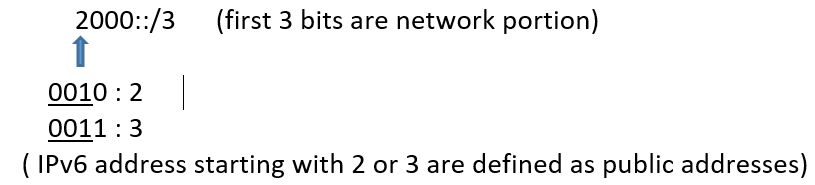
- Global unicast addresses:
- These are IPv6 public addresses.
- These are provided by the service providers.
- Multicast addresses:

- EIGRP (IPv4): 224.0.0.10
- EIGRP (IPv6): FF02::A
- OSPF v2 : 224.0.0.5, 224.0.0.6
- OSPF v3 : FF02::5, FF02::6
- RIP v2 : 224.0.0.9
- RIP v6(ng) : FF02::9
- Unique local address:
- These are private IPv6 addresses.

- Link local addresses:
- These are very similar to IPv4’s APIPA addresses.
- With these addresses the device cannot communicate out of their networks.
- But in IPv6 link local addresses perform a lot more functionality than APIPA addresses in IPv4.

- Unspecified addresses:
- :: 0:0:0:0:0:0:0:0 (since it contains all zeros)
- Loopback addresses:
- ::1 0:0:0:0:0:0:0:1
Configuring IPv6 on cisco router:
- Configuring IPv6 addresses on the interface of the router:
- Manual configuration of IPv6 address on an interface (static IP)
- Stateless auto configuration ( EUI-64 )
- Statefull configuration (through DHCP server) (Dynamic IP)
- By default cisco routers do not route IPv6 data.
- By default routers route IPv4 data.
- In IPv6 by default routers acts as IPv6 hosts.
- To enable IPv6 routing on cisco router
- R(config)#ipv6 unicast routing
Stateless auto configuration:

- In stateless configuration the first 64 bits (network portion) of the IPv6 network is sent by router within Router advertisement message, the next 64 bits are calculated using EUI-64 method
- Link local addresses is pre-configured on that interface when we enable IPv6 on that interface of router.
- Link local address : FE80::/10
- First 10 bits are network bits, the next 54 bits all are zeros and the last 64 bits are calculated using EUI-64 method.
- Global unicast addresses are made up of two components
- Subnet ID (64 bits)
- Interface ID (EUI-64 bits)
- Subnet ID contains:
- The registry (which is responsible for assigning it, such as IANA)
- The ISP prefix (which ISP is associated with this address)
- The site prefix (which company is associated with the address)
- The subnet prefix (subnet within the site)
EUI-64 (Extended Unique Identifier – 64)
- EUI-64 is obtained by inserting FF FE in between MAC address of the system to fulfil 64 bits.
- EUI-64 (Extended unique identifier 64)
- Step 1
- MAC address (48 bit value)
- FFFE (16 bit value)
- Step 2
- Insert the FFFE value between the MAC address.
- 48 bit MAC address
- 24 bits FFFE 24 bits
- Insert the FFFE value between the MAC address.
- Step 3
- 7th bit from the start is inverted.
- Step 1
- EUI-64 (Extended unique identifier 64)
Note: In the MAC address the following bits have some identification.
7th bit: (G/L) (Global/Local) 8th bit: (I/G) (Individual/Group)

IPv6 addressing scheme:

 Network Lessons